I'm on a book-reviewing tear! Or something. Actually I decided to make an effort to review any book I read. I read a lot of short fiction these days, but trying to review something like an Asimov's doesn't make sense to me. Read Locus Magazine if you want that. But I think it's probably reasonable to write a review of anything book length, so here we are. Mixed in with my recent splurge of Old Man's War books I read a nonfiction book as well - Pale Blue Dot by Carl Sagan. You can get the book from Amazon at the link above, but I got my copy by signing up for a three year membership in The Planetary Society. If you think space exploration is worth pursuing there are worse places to throw a few bucks.
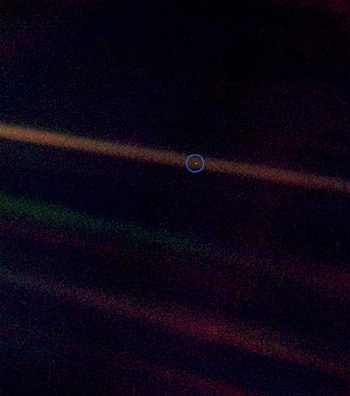
Pale Blue Dot is inspired by this photo taken by Voyager 1 in 1990. The bright spot is Earth. Sagan had fought to get the picture taken, it has minimal science value but he felt it was the next step after the "Earthrise" photo from Apollo. and that mankind needed to see Earth from 4 billion miles away.
This book, to put it simply, is a fantastic read. It's a tiny bit dated these days (it talks about Cassini and Huygens as probes on the drawing board and not probes that actually returned increadible images last year), but the science is still pretty intact. This is simultaneously an indictment of current NASA where nothing has changed in the last 13 years, and an endorsement of the gripping prose that Sagan is famous for. Even when I said to myself "well that's dated" it was still a good read. Space exploration lost a great communicator when Sagan passed away, and his is a voice that is sorely missed in this day and age of religious fundamentalism and short-sighed policies.
The book cover both some philosophy of why we should explore space, where we should use robots vs where we need humans, as well as a remarkably current snapshot of what we know about our solar system. As Wikipedia puts it:
Pale Blue Dot: A Vision of the Human Future in Space (1994) is a non-fiction book by Carl Sagan. It is the sequel to Cosmos and was inspired by the "Pale Blue Dot" photograph, for which Sagan provides a sobering description.[14] In this book, Sagan mixes philosophy about the human place in the universe with a description of what was known about the solar system at the time the book was published. He also details a human vision for the future.[15]
Pale Blue Dot - Wikipedia, the free encyclopedia
The book opens by discussing the wandering nature of mankind but quickly moves onto what Sagan describes as "The Great Demotions" as human science moved from a Earth-centric view to (relucantly) a Sun-centric view, to realizing that even the Sun is really just an "uncharted backwaters of the unfashionable end of the western spiral arm of the galaxy." (that last bit is from Hitchhiker's Guide to the Galaxy. Some people would say that mixing Sagan and Adamns is odd. Those people are wrong. Some people would say if we understood the connection the planet would overall be a much better place to live. Those people are right.) The Great Demotions took centuries and human culture, human religion, and human nature resisted each one, but here we are today where anybody not wearing blinders will accept that cosmologically speaking there's nothing particularly special about the Earth.
From the Great Demotions he begins to move through the Solar System, discussing what is known about all the planets and all the major moons. The thing that is the most striking is how little of this is dated in the last thirteen years. We know a lot more about Mars where Spirit and Opportunity continue to astound anybody who cares to pay attention, but there's dashed little science being done about Venus, or Mercury, or even Jupiter. I'll give NASA credit for Saturn - Huygens may have returned the most surprising data, but Cassini has done some excellent science, and it's not like Huygens would have even gotten there without Cassini driving the cab. But for the most part Pale Blue Dot will get you current if you have no idea what's happened in the Solar System other than the Pluto brouhaha.
He also covers the major explorations - Viking, Pioneer, and Voyager. Note the timeframe - all of these predate the Space Shuttle and "better, faster, cheaper" over at good ol' NASA. To me this was all recap, but it's recap of things I haven't really paid attention to in years, so it was sort of revisiting childhood friends to discuss the great space probes of the 70's.
After we go through what we know and how we found it Sagan moves to discussion of humanity's future in space. Should we explore with manned craft? Why? What can we gain and what are we risking? Of course, Sagan's conclusion is likely obvious to anyone but it's worth the effort to see his why's and wherefores. The discussion about handling near Earth Orbit asteroids alone is very relevant to today's society and worth the price of admission.
So what didn't I like about this book? The printing I have doesn't have any of the photographic plates. Every image he references is easy to find on the web, but it's odd that Pale Blue Dot doesn't even bother to have the image that inspired the book - at the very least I think it'd make a better cover than the goofy Sci-Fi "rockets & Jupiter" image that it has. The images are so key to the humanist appeals that Sagan makes in the book that it's frustrating to not have the pictures at your fingertips. The text specifically references them so I assume an earlier edition contained the color images and that this one doesn't for cost reasons. But that's a minor issue, the book is well worth reading despite the need for external Googling. And frankly in today's day and age, it's refreshing to read a book that assumes that everything will eventually be All Right(tm). Even if it is missing a few photographic plates.
If you care about the future of the species or if you're interested in space exploration I'd recommend Pale Blue Dot as an excellent read. Even if neither of those strike a chord with you, I'd urge you to read the book anyway and see if Sagan can change your mind. He's a much more compelling author and scientist than I am ;-)
technorati tags:Science, space, PaleBlueDot, CarlSagan, BookReviews
Blogged with Flock
